REST API Design in Node vs Flask: A Tactical Comparison
Posted on
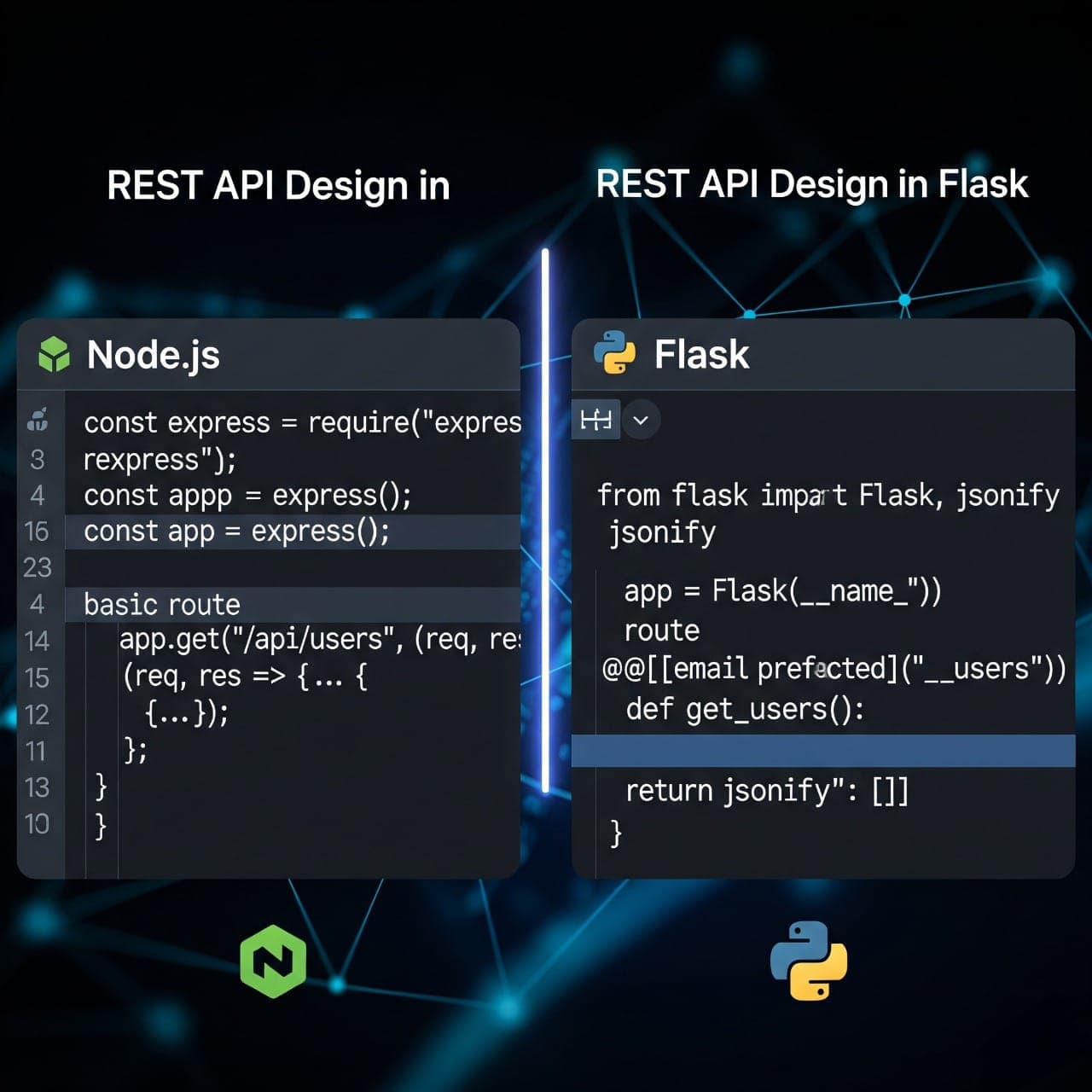
Both Node.js (Express) and Flask are powerful for building APIs. Here’s how I decide which one to use for a given project.
Choosing the right backend framework isn’t ideological—it’s strategic. Node.js with Express shines in full-stack JavaScript environments: shared TypeScript types, NPM ecosystem, middleware flexibility, and seamless React integration. It’s a natural fit when your frontend and backend live in the same language. Bodies and routes defined in TypeScript increase type safety and reduce misalignment between client and server. Flask, on the other hand, offers unmatched speed of iteration for data-centric use cases. Its minimalism and Pythonic syntax make it ideal for prototypes, microservices, or integrations with data libraries like Pandas and Scikit-learn. You can spin up API endpoints in minutes, iterate quickly, and leverage strong Python data tooling—all with fewer dependencies and minimal configuration. In my approach, I choose based on project scope: If I’m building an internal analytic dashboard or ML-backed tool, Flask is faster to iterate and easier to pair with Jupyter notebooks or data pipelines. If I’m building a customer-facing SaaS product with shared code, React frontend, and strong type alignment, Node.js + Express (or TypeScript-backed server) is the better tool. I build robust middleware layers, error handling, logging, and authentication (Passport.js or custom handlers). Regardless of framework, my architectural guidelines stay consistent: design based on client needs, keep request validation strict (using Zod or WTForms), version your API, and enforce contract-first thinking. I always log all requests and errors for traceability and debugging. The real value lies not in the framework, but in the discipline: modular routes, strict types, minimal dependencies, clear error models, and test coverage. Whether it’s Flask or Express, I build scalable APIs that are predictable, maintainable, and secure. That’s an architectural promise, not just a tech preference.